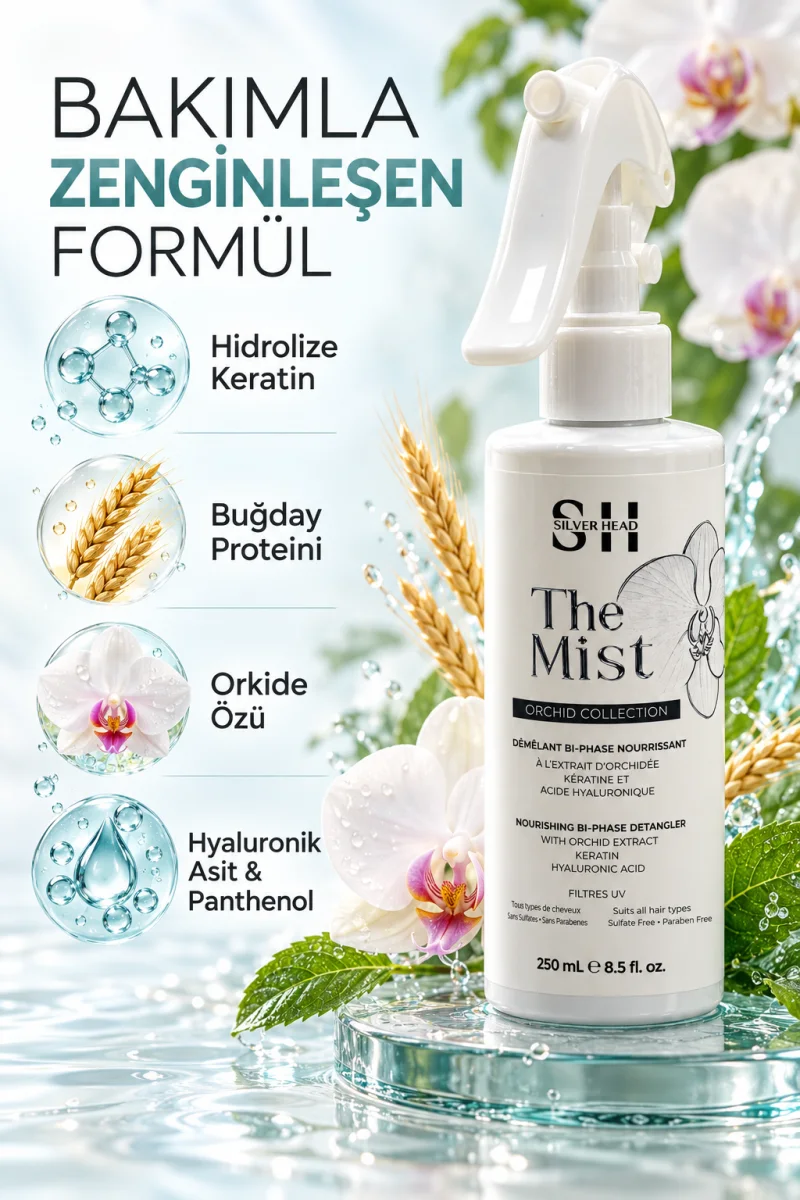
What Is Panthenol (B5)? What Does It Do for Skin and Hair?
Other names: Provitamin B5, D-Panthenol, Dexpanthenol
Panthenol is a care ingredient that, when applied to the skin, converts to vitamin B5 (pantothenic acid) and attracts water; it may help support the feeling of moisture in skin and hair, and the recovery of the barrier in skin. The most solid data is on moisture and water loss; findings on hair strand strength are limited to the laboratory. There is no evidence that it stops hair shedding; a doctor should be seen for eczema that does not go away or a deep wound.
See products for youAt a glance
- INCI name
- Panthenol
- Type
- Vitamin B5 precursor, moisture-retaining ingredient
- What it does
- Moisture and barrier support; moisture feel in hair and easy combing
- Typical concentration
- In the comparative study, 1% and 5%; the most suitable ratio is still uncertain
- Suitable for
- Dry, tight skin and a weakened barrier
- Caution
- Rare contact allergy has been reported; see a doctor for deep, dirty or infected wounds
What's on this page?
- Panthenol, dexpanthenol, B5: Are they the same?
- What does panthenol do? By evidence level
- Panthenol, glycerin or hyaluronic acid?
- What percentage of panthenol works?
- What can you expect from panthenol in hair?
- Where does panthenol fit in skin care?
- Allergy and side effects: Rare but not zero
- Wrong conclusions drawn about panthenol
What panthenol does: By attracting water, it helps maintain the moisture of skin and hair and helps a weakened skin barrier recover. It is a precursor of vitamin B5; most people tolerate it well, and its most solid data is on moisture and water loss. It is also used on superficial small wounds, but for deep wounds, signs of infection or eczema that does not go away, you need to see a doctor. There is laboratory data on hair strand strength, but no evidence that it brings back hair that has fallen out.
Panthenol, dexpanthenol, B5: Are they the same?
These three names are often used interchangeably in most writing, but they do not describe exactly the same thing. Knowing what you see on the label also calibrates your expectations.
- Pantothenic acid (vitamin B5): The vitamin the body uses to make coenzyme A. Coenzyme A takes part in many reactions, including fat and protein metabolism.
- Dexpanthenol (D-panthenol): The stable alcohol form of pantothenic acid. When applied to the skin it converts to pantothenic acid. Most clinical studies were done with this form.
- Panthenol: The general name on cosmetic labels. The product may contain only the D form, or a mixture of D and L forms. You cannot tell which one it is by reading the label.
Do not overload the word "vitamin" with meaning either. Applied panthenol is not used to fill a deficiency in the body. Its real job in the product is to hold water and support the upper surface layer of the skin. In cosmetic safety assessments it is also described as a hair care agent, humectant and solvent.
What does panthenol do? By evidence level
Use the table below to weigh claims. The last column shows how far the data goes for each heading.
| Claim | What is known? | Strength of evidence |
|---|---|---|
| Skin moisture and water loss | In one-month forearm measurements, formulas containing 1% and 5% reduced water loss through the skin | Reasonable, but measurements were short-term |
| Barrier after cleansing | In skin washed with a sulfate cleanser, water loss was lower 2 hours later | Limited, immediate effect |
| Superficial wounds and abrasions | In controlled studies, renewal of the upper skin was accelerated compared with a carrier cream | Reasonable, with most special wound formulas |
| Sun-induced redness | A soothing effect was observed in experimental UV redness | Limited; does not replace sun protection |
| Hair strand strength | Breaking strength increased in measurements on the strand | At laboratory level |
| Thinning hair | Studied only together with caffeine and other agents | Weak; no data on its own |
How it works is not fully resolved either. It is thought to make the fat and protein molecules in the upper skin layer more mobile, and to change the activity of some genes involved in wound closure. Some of these findings come from the laboratory; you should not expect results of the same magnitude from the cream on the shelf.
Panthenol, glycerin or hyaluronic acid?
All three are water-attracting ingredients and are often found side by side in most moisturizers. You do not have to choose among them; there is no known disadvantage in using them together. There is also no strong direct comparison showing one is superior to another. The differences mostly emerge from where the data has been collected.
| Ingredient | Standout feature | Where do you see it? |
|---|---|---|
| Panthenol | Besides moisture, there is data on the barrier and superficial wounds, and it has also been studied in hair | Barrier creams, wound creams, hair products |
| Glycerin | Long-used, common and inexpensive humectant | Almost every moisturizer and cleanser |
| Hyaluronic acid | Large molecule, holds water on the skin surface | Serums and light moisturizers |
What percentage of panthenol works?
In one of the few studies directly comparing ratios, formulas containing 0,5%, 1%, and 5% panthenol were applied daily to the forearms of healthy people. After 30 days, water loss decreased significantly in the 1% and 5% groups, and the same result was not reported for 0,5%. The researchers associated the protective effect with the 1% formula. From this, the following can be drawn:
- 5% is not superior to 1%. This study does not show that a higher ratio is better. The most suitable ratio is still an open question.
- The base formula matters. The same ratio does not give the same result in every cream. Water-in-oil emulsions are cited as a good carrier for passage into the skin.
- Order is not percentage. The ingredient list is written in decreasing amount, but ingredients below 1% may appear in the list in any order. So you cannot calculate the ratio by looking at the list.
- In rinse-off products, expectations drop. In a 4-week study of 44 people with a dexpanthenol body cleanser, moisture increased by a small margin over water, while water loss did not change.
What can you expect from panthenol in hair?
The most interesting data for hair comes from a recent laboratory study. Labeled panthenol was seen to enter the protein-rich inner part of the hair strand. Strands treated with panthenol showed higher breaking tension and flexibility measures than control strands. The researchers attribute this to hydrogen bonds between panthenol and hair proteins. Still, this is a measurement on the strand; it does not tell how much breakage is reduced in people's daily use.
In the best-known study on fine hair, panthenol was not used alone but in a product left in the hair together with caffeine, niacinamide, dimethicone, and an acrylate polymer. The diameter of existing strands increased by 2-5 micrometers, and the cross-sectional area grew by about 10%. The study is industry-linked, and panthenol's share cannot be separated out. The authors state that cosmetic products will not reverse thinning, but can only lighten its appearance.
You can frame your expectation by product type as follows. This ordering is an example derived from contact time logic, not based on a study directly comparing product types.
| Product | Contact | Realistic expectation |
|---|---|---|
| Shampoo | Minutes, then rinsed | Softer feel after cleansing, easy combing |
| Hair conditioner, mask | A few minutes | Better slipperiness and moisture feel |
| Leave-in spray, serum | Until the next wash | Moisture feel and easier combing; longest contact time |
If you have broken ends or chemical damage, panthenol alone is not enough. You can find protein ingredients in the keratin article and protection before blow-drying in the heat protectant article.
Where does panthenol fit in skin care?
Panthenol is not a routine on its own; it accompanies other steps. You can see below how to think about it in different situations.
| Your condition | How to use | Its limit |
|---|---|---|
| Dry, tight skin | A panthenol moisturizer or serum on lightly damp skin after cleansing. It can be in the same routine as hyaluronic acid | If flaking lasts for weeks, the cause should be investigated |
| Weakened barrier | A simple, fragrance-free formula. Pause active products. Can be considered together with ceramide creams | If stinging continues, reduce the number of products |
| Acid or retinol use | In the same evening, in the moisturizer step | Does not reset irritation; reducing frequency is more important |
| Small scrape, crack | Fragrance-free, dexpanthenol product made for wounds, after washing | See a doctor for deep, dirty or inflamed wounds |
| After sun exposure | If there are no blisters on the skin, a simple moisturizer step | See a doctor for blisters, fever, or widespread burns |
Allergy and side effects: Rare but not zero
Scientific safety assessments consider panthenol safe under the conditions in which it is used in cosmetics. The risk of irritation is considered low. Even so, saying it "never causes allergies" would be wrong. In an older case series, contact allergy to dexpanthenol was reported in 11 people, some of whom had leg wounds or eczema related to leg circulation. Among recent case reports there is also an allergy causing delayed healing of a wound, and a reaction attributed to a barrier cream.
- Test a new product on a small area first: On the inner arm or elbow crease, twice a day, for 7-10 days. If redness, itching or swelling occurs, stop using it.
- If your wound worsens contrary to expectations: Tell your doctor about the product you applied. If you have multiple allergies or a long-open wound, the likelihood of allergy becomes more important.
- Pregnancy and breastfeeding: Data specific to panthenol is limited. Show the products you will use to your doctor or pharmacist.
- Baby and young child: Ask your pediatrician about a product used for diaper rash or eczema.
Wrong conclusions drawn about panthenol
- "It's on the list, so it repairs." An ingredient being in the product says nothing about its amount or the base formula.
- "My shampoo will stop hair loss." There is no evidence for panthenol in hair loss. See a doctor for sudden-onset, long-lasting or patchy hair loss.
- "If it soothes, I don't need sunscreen." Panthenol is not a UV filter. During the day, apply a broad-spectrum sunscreen of at least SPF 30, reapply every 2 hours, and after sweating or swimming.
- "I can apply it to any open wound." A perfumed cosmetic wound cream does not replace treatment. Animal bites, dirty cuts and wounds with spreading redness are the doctor's job.
- "I'll handle my eczema myself." A panthenol moisturizer can accompany care, but eczema that does not go away or whose itching disrupts sleep requires evaluation.
- "Three panthenol products are better." There is no data showing that stacking the same ingredient brings extra benefit. Add new products one at a time so that if a reaction occurs you can identify its source.
This page is for general information only and does not replace medical diagnosis or treatment. If you have an ongoing skin or scalp problem, consult a dermatologist.