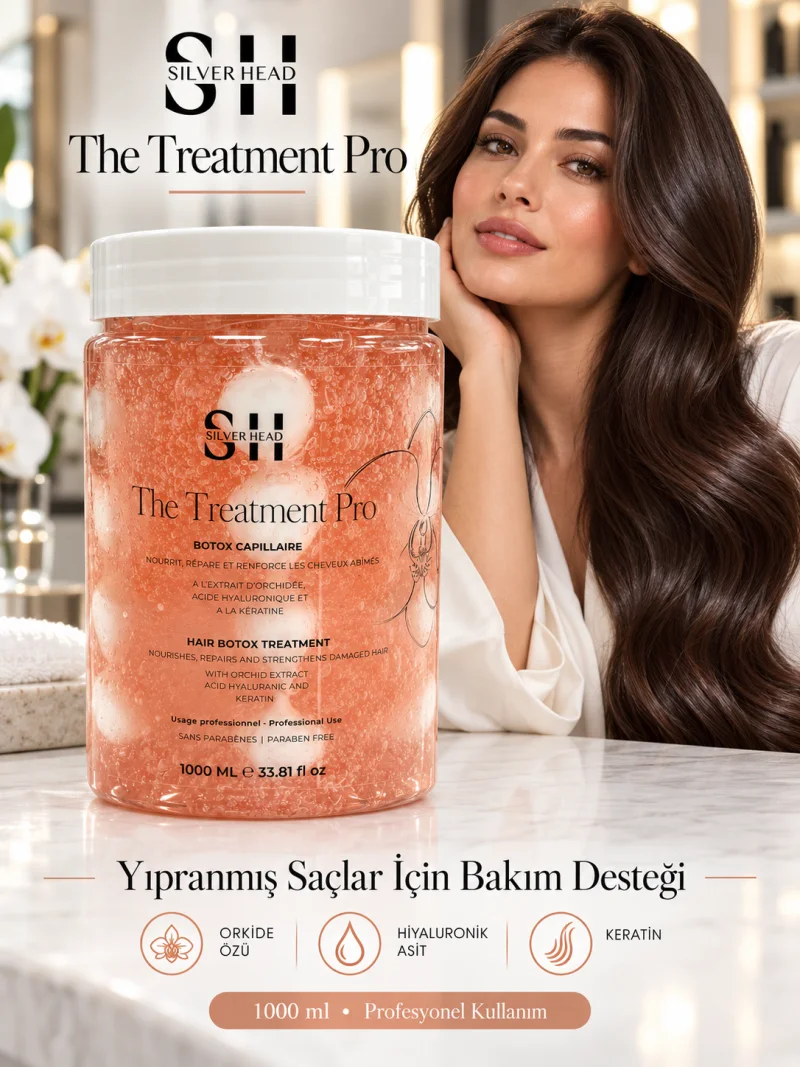
What Is Hair Botox? Its Difference from Keratin Care and Expectations
Hair botox is a marketing name given to care or straightening products; it contains no botulinum toxin and has no legal or scientific definition. The same name can describe a mask rinsed at home or a chemical treatment fixed with heat in a salon, so you need to look at the ingredient list. Its effect is temporary, and it does not solve hair loss.
See products for youAt a glance
- Type
- Marketing name; can be a care mask or chemical straightening
- What it does
- Smoother, easy-to-comb hair; in salon form, reduced frizz and curl
- Durability
- In a mask it decreases with washing; in salon form, a few weeks to about 2 months
- Commonly confused concept
- Botulinum toxin injection, which is a prescription drug
- Caution
- Formaldehyde and glyoxylic acid; do not have a treatment done without checking the ingredient list
What's on this page?
- What is hair botox, and where does its name come from?
- What goes into it?
- At home or in the salon? Two different treatments
- How is it different from keratin care?
- Safety: formaldehyde and glyoxylic acid
- Home straightening kits are a separate topic
- Ask before sitting in the salon chair
- Who should avoid it or ask their doctor first?
- Realistic expectations
- Three questions about hair botox
The answer to "what is hair botox?" is this: it is not a drug, but a marketing name given to care or straightening treatments; products sold under this name contain no botulinum toxin and have nothing to do with injections. The same name can be carried by a care mask rinsed at home, or by a chemical straightener fixed with heat in a salon. So you need to decide from the ingredient list, not from the name. Its effect is temporary, and it is not a solution to hair loss.
What is hair botox, and where does its name come from?
The name is borrowed from botulinum toxin injections used for wrinkles. Its association is smoothness and fullness. Botulinum toxin, however, is a prescription drug that blocks the signal traveling from nerve to muscle. A hair strand is not living tissue; it contains no muscles or nerves. So there is no target on the hair strand where this drug could act.
The phrase "hair botox" has no legal or scientific definition. So two products sharing the same name do not necessarily share the same content. There is also a separate topic not to be confused with it: there are small studies using actual botulinum toxin injections for hair loss. These have nothing to do with the care products called hair botox; they are physician procedures and not a standard method.
What goes into it?
The formula varies from manufacturer to manufacturer, but two main groups can be distinguished.
- Care mask type: Hydrolyzed keratin, collagen particles, amino acids, plant oils, moisture-retaining agents such as hyaluronic acid, silicones and conditioning agents. It is a rinse-off hair care product.
- Straightening type: In addition to the above, straightening agents such as glyoxylic acid and carbocysteine. Some may contain preservatives that release formaldehyde with heat. It is set with heat and reduces curl.
On the label, or on the packaging shown by the salon, look especially for these names: Formaldehyde, Formalin, Methylene Glycol, Glutaraldehyde, Glyoxylic Acid.
At home or in the salon? Two different treatments
| Feature | Home care mask | Salon heat-set treatment |
|---|---|---|
| What is done? | Applied to washed hair, left briefly, rinsed | Solution applied, left, then set with a blow-dryer and straightener |
| Heat | None, unless the label says otherwise | A straightener is used; temperature varies by salon and product |
| Effect on curl | Not intended to straighten | Curl may reduce, frizz may decrease |
| Durability | A temporary look that fades with washing | A few weeks to about 2 months, according to limited data |
| Risk | Generally at the level of product allergy and irritation | Gas released by heat, hair damage, rarely a systemic reaction |
| Caution | Follow the label, avoid eye contact | Full ingredient list, ventilation, temperature |
You can tell from the label whether your product falls into the home group: if the use consists of applying it to washed and towel-dried hair, leaving it for a few minutes and rinsing thoroughly with plenty of water, and the instructions include no heat or straightening step, then it is a care mask. You can find general rules on how to apply it as a mask in the how to use a hair mask article.
How is it different from keratin care?
The two are often confused, because both are sold on the promise of smooth hair, and salon-type hair botox can resemble keratin treatment. The known differences are as follows, but much of the information in the hair botox column comes from expert opinion rather than clinical studies:
| Feature | Salon-type hair botox | Keratin treatment (straightening) |
|---|---|---|
| Definition | No legal or scientific definition | Aldehyde derivatives and chemical straightening with heat |
| Heat | Usually lower, sometimes none | Around 230 °C, with 15-20 passes over the same spot |
| Duration | A few weeks to about 2 months | About 2-6 months, depending on the source |
| Formaldehyde risk | Entirely formula-dependent | More frequent and higher |
| Evidence | No randomized studies; very little data | Air measurements, case series and observational studies exist |
For keratin's role in hair and the limits of hydrolyzed keratin in products, see the what does keratin do article.
Safety: formaldehyde and glyoxylic acid
This section applies more to salon heat-set treatments than to masks rinsed at home.
Formaldehyde
Formaldehyde, or substances that release it, gives off gas when heated. Inhalation and contact can cause watery and burning eyes, irritation of the nose and throat, cough, wheezing, headache, nausea and rash. Allergy may develop with repeated contact. Formaldehyde is classified as carcinogenic to humans in association with long-term or high-level exposure. For salon workers, exposure is repeated much more often.
The label alone is not enough. It has been reported that measured values can exceed occupational limits even in products labeled "formaldehyde-free."
Glyoxylic acid
Glyoxylic acid, used as an alternative to formaldehyde, is also not without problems. A systematic review dated 2025 examined 36 episodes of acute kidney injury associated with hair straightening products, seen in 34 women. In 20 of these, a product labeled "formaldehyde-free" had been used; the content of the rest was unknown. In most cases where a biopsy was performed, oxalate crystals were seen, and glyoxylic acid stands out as the main suspect. Complaints mostly started within 48-72 hours after the procedure: vomiting, nausea, abdominal and flank pain, and rash on the scalp. All patients recovered, but some required dialysis.
Because these data are based on case reports, they do not establish a definite cause and effect, and they do not say how common such a reaction is. Still, the simple thing to do is this: if vomiting, abdominal or flank pain, or reduced urination occurs within a few days after a hair straightening treatment, seek medical care without delay and be sure to mention the treatment you had.
The hair strand itself
In a laboratory study, a very low-pH straightener containing glyoxylic acid and carbocysteine was applied to hair strands at 180 °C with 10 passes. The measurement showing the keratin structure in the cortex fell by about 70 percent. In bleached hair, this drop rose to about 88 percent, and average porosity increased from 3 percent to about 12 percent. This is a strand experiment and cannot be generalized to every product. But it is a sufficient warning to think twice before having this kind of treatment done on bleached hair.
In another comparative study, all chemical straighteners caused protein loss in hair, with the greatest loss seen with glyoxylic acid. The authors attribute this to the product's pH being below 2 and to the high heat required. Even so, the findings do not fully agree; there are also studies showing no comparable damage. The lesson: a label saying "acidic," "natural" or "formaldehyde-free" does not make the process harmless by itself.
Home straightening kits are a separate topic
Not every "hair botox" sold is a mask rinsed at home. If a kit requires fixing with a straightener, you may breathe in more of the gas released in a poorly ventilated bathroom. If the label has no heat step, no information on processing time, no eye contact warnings and no full ingredient list, do not try this product at home. Passing the straightener over the same spot repeatedly also increases hair damage.
Ask before sitting in the salon chair
- Can I see the product packaging and the full ingredient list? If there is no list, or no one who knows its contents, do not have the treatment done.
- Will heat be used, at what temperature and how many passes? You can read about heat's effect on hair in the heat protectant article.
- How is the ventilation? If your eyes sting or your throat becomes irritated during the procedure, ask for it to be stopped.
- What happens if my hair is bleached or colored? One treatment at a time is recommended. If you will color after straightening, the general advice is to wait two weeks.
- What do I need to do afterward? Salon treatments may come with special instructions for the first wash and shampoo choice; ask for them in writing.
If you have reacted to a hair treatment before, say so at the start. If the specialist is not sure whether the product contains formaldehyde, and especially if you have had a reaction in the past, it is more sensible to give up the treatment.
Who should avoid it or ask their doctor first?
- Pregnant and breastfeeding women: Consult a doctor before deciding on treatments that can release gas with heat.
- People with asthma or chronic lung disease: Gas released in the salon can worsen complaints.
- People with eczema or an allergy to fragrance or preservatives: The risk of reaction is higher.
- People with kidney disease: Because of the case reports above, ask your doctor first.
- Children and adolescents: Particular caution should be taken with this kind of chemical treatment.
- People with a wound, burn or sunburn on the scalp: They should wait until the skin heals.
Realistic expectations
With mask-type products, what you can expect is similar to what a cream or mask does: hair may feel slipperier for a while, comb more easily, and look temporarily fuller as the strands are coated on the surface. In a salon-type treatment, reduced frizz and curl can be added to this.
What you should not expect is also clear:
- It does not restore the strand's structure. A broken and burned strand remains broken and burned.
- It does not reach the scalp or the root, does not treat hair loss, and does not stop thinning.
- It does not speed up hair growth.
- It is not permanent and requires repetition. Each repetition also renews the risks above.
If hair has started to thin or is shedding noticeably, the solution is not hair botox but a dermatologist consultation to investigate the cause.
Three questions about hair botox
Does hair botox straighten hair?
It depends on the product. Mask-type ones do not straighten; at most they can ease frizz and combing. Those containing agents such as glyoxylic acid and set with heat can reduce curl, because they are straightening treatments.
What is the difference between hair botox and a hair mask?
Hair botox products used at home are often a hair mask. A difference in name does not mean a difference in content. For a comparison of mask and cream, see the difference between hair cream and hair mask article.
How often can it be done?
There is no evidence-based frequency for salon-type treatments. Leaving space between chemical treatments is the general rule; in winter, a gap of 8-10 weeks or longer is recommended. For rinse-off masks used at home, follow the product label.
This page is for general information only and does not replace medical diagnosis or treatment. If you have an ongoing skin or scalp problem, consult a dermatologist.